Technology and regulation are both moving in real time, each reacting to the other and each trying to stay one step ahead. With advancements in AI, we face a familiar situation: the imperative to govern powerful technology, balanced against the risk that governance could hamper that technology’s potential for innovation.
While comparisons to the early dot-com era are frequent: “AI is more like nuclear fission: new technology with tremendous applications, some of which could cause significant harm if not carefully controlled,” says Kayvan Hazemi-Jebelli, vice president for Europe at the Chamber of Progress in Brussels.
Carefully or otherwise, attempts to control AI are coming fast and frequent. On 12 June, the US Department of Commerce issued an export control directive ordering Anthropic to suspend access to its Fable 5 and Mythos 5 models for any foreign national. This scope was so broad that Anthropic, unable to screen users by nationality, disabled both models entirely for all customers worldwide. Four days later, on 16 June, the European Parliament voted to approve amendments to the EU AI Act, in many cases to postpone legal obligations for AI systems.
‘AI is more like nuclear fission: new technology with tremendous applications, some of which could cause significant harm if not carefully controlled’
Together, these events signal that while there is widespread agreement about the need for regulatory intervention, the specifics are still very much up for debate.
Regulating for responsible AI
“There is no global approach to rules on artificial intelligence,” confirms Giulio Coraggio, partner at DLA Piper. “There is a kind of a patchwork of three distinct philosophies, shaped by different legal traditions, state industry relationships and views on risk. All speak about responsible AI, but then they have different approaches.”
The EU’s model is the most architecturally ambitious: a risk-based, ex-ante regime that calibrates obligations to the level of harm a system could cause. It sits atop a layer of prior digital legislation: the GDPR, the Data Act, the Digital Markets Act and a constellation of sector-specific instruments, totalling roughly fifty regulatory instruments with some bearing on AI agents. “Europe is probably the most stringent regulator, so it’s a very interesting regulatory experimentation to observe,” says Alexandre de Streel, professor of European law at the University of Namur. “There is a perception in Europe, rightly or wrongly, that in the platform economy, they intervened too late, and that’s why it’s so complicated to reverse to more competition and more openness.” Given this history, the European Commission is particularly focused on responding quickly to emerging AI technology.
‘There is no global approach to rules on artificial intelligence. There is a kind of a patchwork of three distinct philosophies, shaped by different legal traditions, state industry relationships and views on risk.’
With no comprehensive federal legislation and an administration that has rolled back the executive interventions of its predecessor, the operative philosophy of the United States government is market self-regulation. “The US is adopting an approach where the market is going to set its own rules, but we have seen already some situations where that wasn’t enough,” explains Giulio. Sector-by-sector oversight (the FDA for medical devices, the FTC for consumer protection, the CFPB for financial services) fills some gaps, but the overall disposition is that regulatory constraint risks ceding ground to competitors, notably China. “The US has an enormous market influence on the growth of artificial intelligence because the main AI providers are based there,” Giulio adds. “They are setting the standards.”
The UK occupies a middle ground: principle-based, sectorally distributed and with a preference for flexibility. Its regulators, including the ICO, FCA, Ofcom and the CMA, operate with considerable autonomy. However, as Giulio notes, “there are big questions whether these open principles are enough.”
Clarity on goals, flexibility on means
Even as regulators work to define limitations and obligations for AI systems, the operators of those systems are continuing to develop the technology. But for AI firms, the lack of regulatory clarity creates difficulties of its own. Catherine Chapple, counsel for Competition & Regulatory Affairs at Google, knows this from experience. “Without clear design benchmarks or safe harbours for agents, businesses face a lot of legal risk when they’re trying to optimise user experience,” she says. “[AI agents] are, by definition, orchestrators. They’re interacting across operating systems, search engines, cloud services, third-party applications simultaneously. With such a fluid, interconnected system, it can make it difficult to know how to comply.”
‘Product and engineering teams really do need clarity on what constitutes compliant design […] Ideal regulation would be clear regarding goals but give flexibility to companies for how to comply with those goals’
As both a regulated entity and a deployer of frontier AI, Google is regularly confronted with the challenge of balancing compliance and innovation. “Product and engineering teams really do need clarity on what constitutes compliant design,” Catherine adds. “Ideal regulation would be clear regarding goals but give flexibility to companies for how to comply with those goals.” And this, she adds, would preferably be “not a category-specific framework, but a consistent focus on conduct and outcomes, using existing competition tools and adapting them where it really is necessary.”
The focal points for the EU: competition, consumer protection and consistency
A common criticism of openness laws like the ones within the EU’s Digital Rulebook is that they are anti-innovation. On the contrary, Alexandre sees these instruments as encouraging innovation. “If you are a small player, you need access to the bigger ecosystem to promote your own innovation,” he points out. Openness obligations such as interoperability and data sharing are therefore pro-competitive by design. He argues that American firms, those perhaps most likely to balk at the openness provisions in EU legislation, are, in fact, major beneficiaries of these provisions.
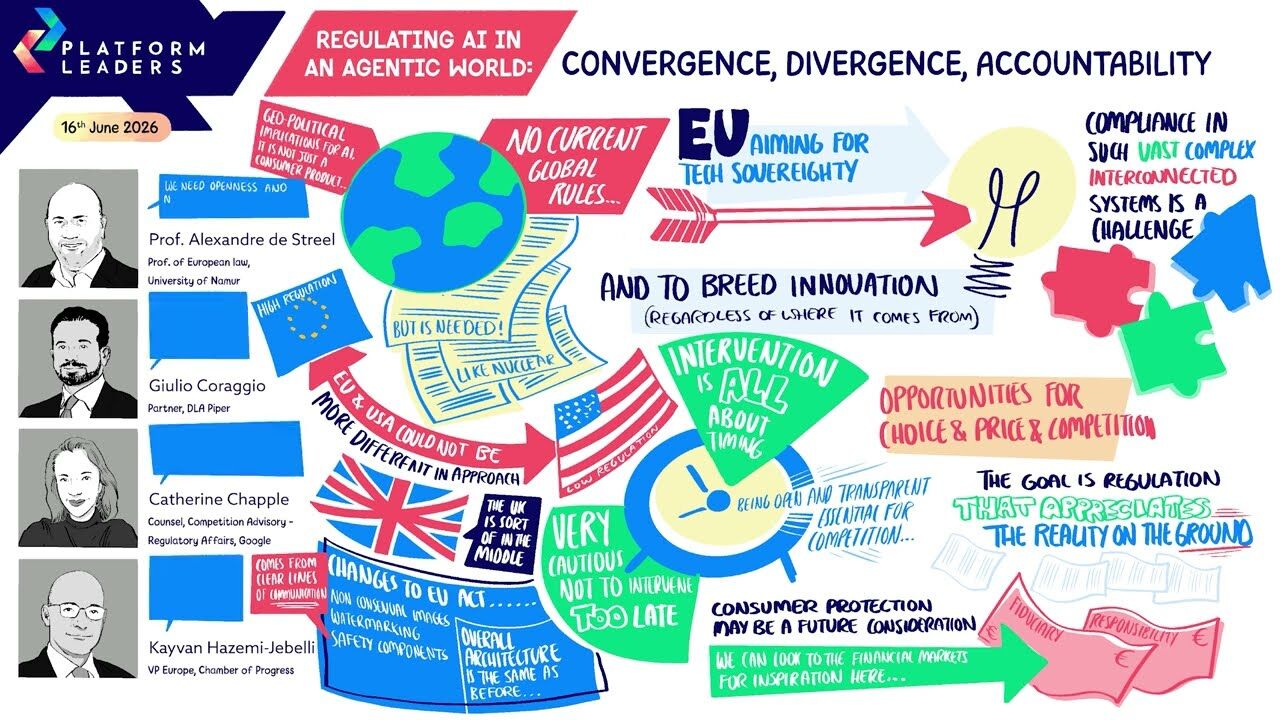
However, Alexandre does suggest additional action is needed to refine the European approach. “The first [action] is to ensure that the market is working well and that there is competition among AI agents [… and] the second issue is in terms of protecting consumers,” he thinks. He also notes that more consistency is needed across the various parts of the Digital Rulebook, which, according to the Draghi report, is administered by more than 270 regulatory bodies at the European Commission and in EU member states. “It’s very important that they [the 270 regulatory bodies in Europe] work consistently with each other, and that’s unfortunately not always the case,” he acknowledges. With varying perspectives on competition, privacy and security, views among regulators often differ. “I wouldn’t say that those [views] are necessarily incompatible, but it’s very important that there is a discussion among all those interests,” says Alexandre.
‘It’s very important that they [the 270 regulatory bodies in Europe] work consistently with each other, and that’s unfortunately not always the case’
The EU AI Act, amended
The Digital Omnibus reforms passed on 16 June refined the EU’s AI Act rather than restructured it. The core architecture remains. However, the timeline has been delayed for several obligations, notably for high-risk systems and for products that are themselves already regulated. “The idea behind the Digital Omnibus is to increase competitiveness of European Union businesses. There was the general perception that EU businesses, or even non-EU businesses operating in the European Union, were not ready to become compliant,” explains Giulio. The postponement of obligations, he adds, is an “acknowledgement by the European Union that the regulatory framework put in place three years ago was too burdensome and was risking to delay the growth of artificial intelligence”. With the newest amendments, EU regulators are signaling their willingness to give firms more time to become compliant.
In Giulio’s view, the amendments were absolutely necessary. “[What] I’ve seen advising companies in dealing with AI systems is that they are running to adopt these solutions, but they don’t have any sort of AI governance model,” he says. “They don’t map the solutions; they don’t do any sort of risk assessment. Basically, if the [EU Digital Rulebook] provisions were becoming applicable in a month and half, then we risk that most of the businesses in the market [would not be] compliant.”
Although some firms may be implementing AI systems without first designing a model for governance, Catherine doesn’t believe it’s always a matter of negligence. “Companies are really doing what they can to move as quickly as they can to be compliant, but they just need more time,” she thinks. Even firms that do have detailed internal governance may struggle to align their operations with new regulation. “At Google, we have been highly regulated for quite a long time, and I think that we really have built very robust processes internally, but even for us, all of these things have been moving so quickly that it is difficult,” she continues. “It’s a very encouraging sign that the goal is to regulate companies in a way that still appreciates the realities on the ground.”
Trusting AI technology and protecting humanity’s role
The emergence of agentic AI systems raises significant questions, many of which sit beyond the scope of existing regulatory frameworks. “It’s no longer a question about product safety, like whether AI chatbot output is biased or unsafe or misleading. It really is whether a system that can plan, use tools, write, code and interact with other systems and pursue delegated goals will continue to do what we actually intend,” Kayvan reflects. “It’s not just ‘can we trust the output of a chatbot?’ It’s ‘can we trust these agents to act autonomously in our digital and increasingly in our physical world?’”
The United States’ decision to restrict Fable 5 and Mythos 5 on national security grounds is a sign of the increased stakes attached to this technology. Competition logic pushes for speed; safety logic urges caution. For her part, Catherine calls for open dialogue. “If we want to protect humanity’s role in this new, quickly shifting world, regulation should be keeping pace,” she says. “[That requires] conversation and collaboration between agencies and businesses to make sure that the regulation is really getting it right and is looking at the common core obligations to protect human outcomes.”
That remains, as ever, the aspiration. How regulators and business leaders can best collaborate on the institutional architecture to deliver it is the ongoing question.
Join the conversation with Platform Leaders
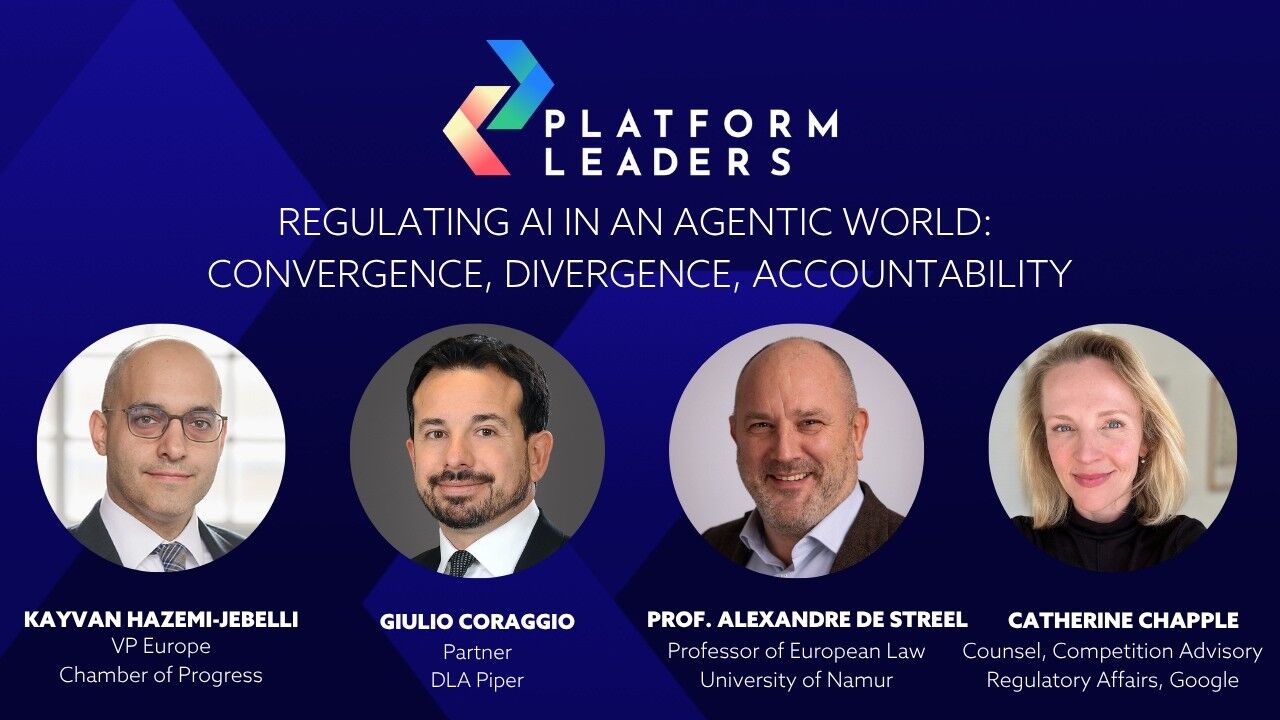
This panel with Catherine Chapple, Giulio Coraggio, Kayvan Hazemi-Jebelli and Alexandre de Streel took place at the Platform Leaders event organised by Launchworks & Co, held online on 16 June 2026. Visit the Platform Leaders website for full recordings, detailed insights and more, and sign up for updates on upcoming Platform Leaders events.
To watch the full event, you can play the video below.
Share this: