Since the launch of ChatGPT at the end of 2022, marketplaces have been watching keenly to see if, and more often, how, AI would affect their business. Indeed, platforms like Chegg lost up to 90% of their traffic almost overnight to large language models (LLMs) capable of answering questions instantly and, within limits, for free. For many founders, these early disruptions were internally destabilising. If AI could replicate the core value proposition of an information-matching platform, the entire marketplace model was under existential threat.
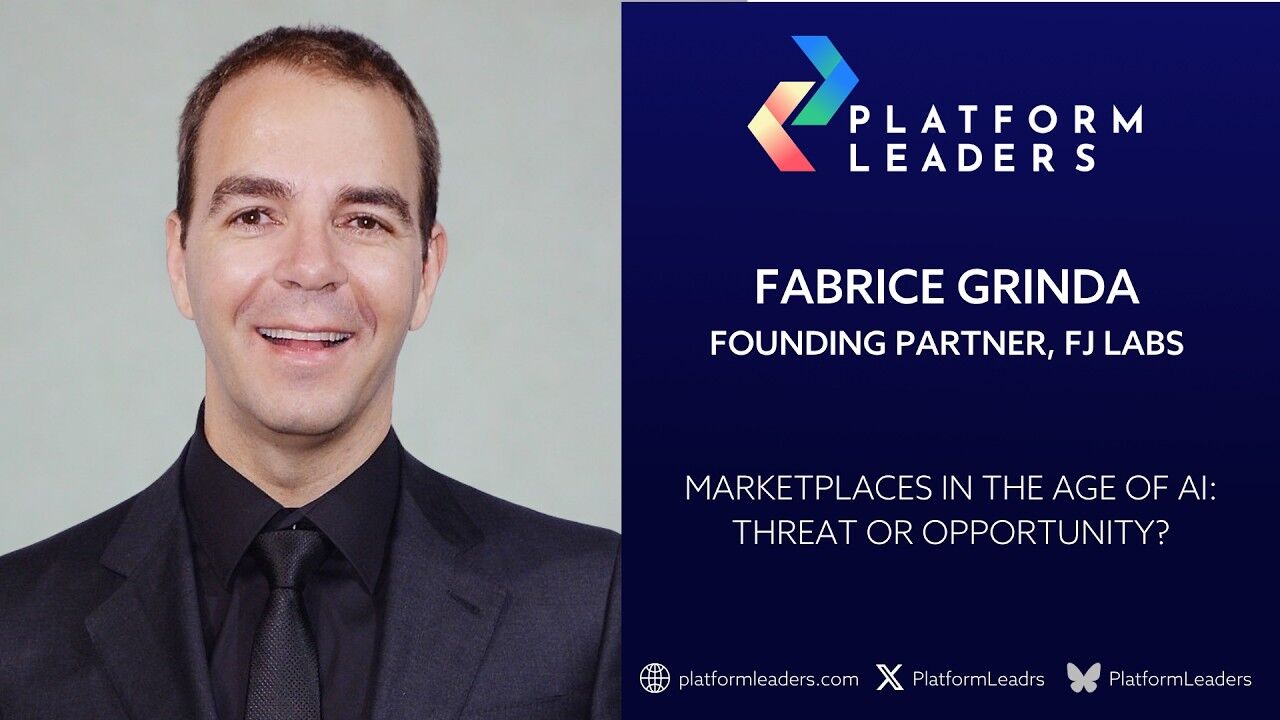
To firms and founders alike, Fabrice Grinda, Founding Partner of FJ Labs and one of the world’s most prolific and experienced marketplace investors, offers reassurance: “I’m actually seeing more opportunity – meaning, things you can do with AI to inflect your business and make it much better – than I’m seeing threats.”
“Tech moves fast, but policy and culture move slowly”
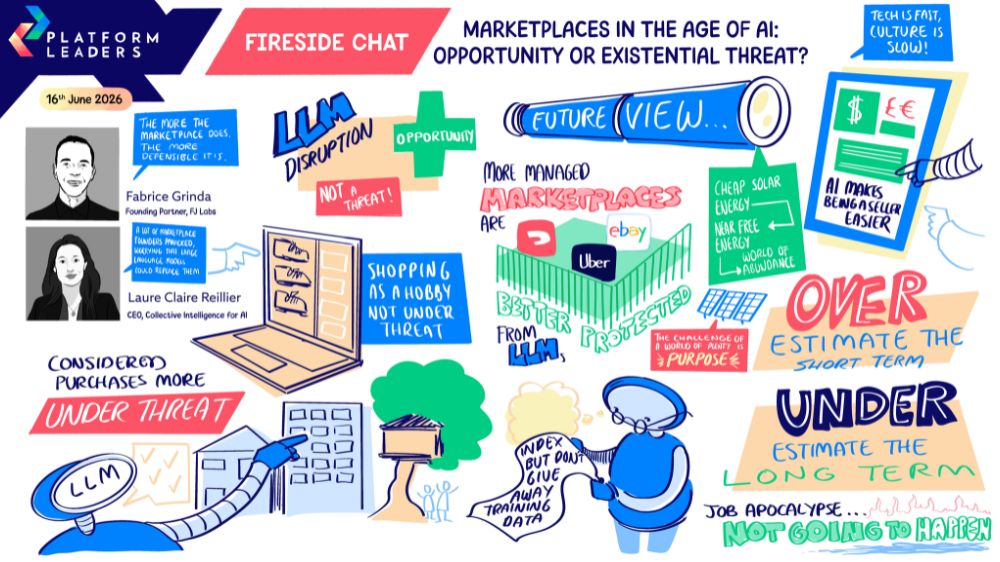
Broadly, Fabrice’s perspective on AI takes into account the longer history of technological advancements, from the commercialisation of electricity to the early internet. “During transitions, people overestimate the impact that the revolution has in the short term and underestimate it in the long term,” he observes.
Looking back on the dot-com boom, Fabrice lists off examples of early web-based firms that were simply ahead of their time. Pets.com may have misestimated the timeline, but was not wrong about the viability of online pet retail. The company that eventually made that model work is now known as Chewy. Webvan’s vision was eventually realised by Instacart. Many ideas of the dot-com era were sound. The infrastructure, consumer habits and regulatory environment, however, were not ready.
Fabrice sees the same dynamic operating today, with the startup world leading the charge in early adoption. “Because we’re all at the forefront of AI implementation, we think it’s happening extraordinarily fast,” he notes. However, the institutions that drive most economic activity, such as governments, healthcare systems and large enterprises, are slower to transition to new technologies. “We’re still at the very beginning of the AI revolution,” thinks Fabrice. “Tech moves fast, but policy and culture move slowly.”
AI as a strategic lever for marketplace operators
While disruption is more targeted, the opportunity is considerably broader. Fabrice identifies three concrete mechanisms through which AI is already generating material value for marketplace operators.
‘I’m actually seeing more opportunity – meaning, things you can do with AI to inflect your business and make it much better – than I’m seeing threats.’
First, Fabrice points to cross-border liquidity. Vinted has used AI-powered auto-translation not only of listings but of real-time conversations between buyers and sellers. This effectively collapses the language barrier that has long fragmented European e-commerce into market silos. The result for Vinted has been a compound expansion strategy: liquidity built in one market becomes the springboard for winning adjacent geographies. Companies in FJ Labs’ own portfolio, including Wallapop and automotive parts platform Ovoco, are achieving similar outcomes.
Another lever is supply-side friction reduction. “In most marketplaces, especially the consumer-facing ones, 99% of people are buyers,” Fabrice explains. “There are not that many sellers, because it takes work to sell. And now with AI, you make selling a lot easier.” Indeed, AI changes the calculus. A user who previously needed to photograph an item multiple times, write a title and description, select a category and research a price can now submit a single image and receive an AI-generated listing ready for review. According to Fabrice, “immediately, you can get a 20-30% uplift in the number of listings” by implementing this kind of supply-side tooling.
The third is customer service automation. As companies in Fabrice’s portfolio have integrated AI agents into their support operations, they’re seeing cost reductions as well as measurable improvements in customer satisfaction. “Many of my companies now have 50% lower customer care costs than they did a year ago, [and] with higher NPS,” Fabrice says. It’s a combination that, not long ago, would have been considered a contradiction in terms.
The strategic question: to index or not to index
As LLMs become increasingly important discovery channels, marketplace operators face another new strategic question: should they allow themselves to be indexed by and surfaced within AI systems like ChatGPT, Gemini or Claude?
“If you’re going to index yourself in Google for SEO, then you should absolutely index yourself in the LLMs,” Fabrice answers emphatically. For the handful of platforms with near-total market dominance (those with 95%+ market share, where users navigate directly without an intermediary discovery step), indexing in LLMs could risk reshaping user habits in ways that could introduce intermediaries where none currently exist. These platforms, which Fabrice says number around three to five globally, are better served by protecting the direct relationship they have with their users.
For everyone else, which is to say, for almost every marketplace, the situation is rather different. LLM usage is currently about a third of search engine traffic, with only 2-3% referral traffic. However, that traffic is free, incremental and seems to be increasing. The appropriate response, Fabrice argues, is to pursue Answer Engine Optimisation (AEO) alongside traditional SEO. “The answer for 99.99% of marketplaces out there is: index yourself on Google, get the free SEO, get the free AEO, be in Gemini, be in Claude, be on OpenAI – no reason not to,” he says, while adding one important caveat: “Index yourself, but don’t let them use you for training data.” Laure Claire adds: “We produced guides at Collective Intelligence for AI to encourage founders to embrace AEO and GSO ( generative search optimisation).” The Search in an AI world report and the practical implementation guide are useful resources to decipher the new visibility rules.
Marketplace activity: protected or not?
While AI disruption is still also taking place, not all marketplace activity is equally vulnerable. Here, Fabrice distinguishes between three categories of buyer behaviour, each carrying a different risk profile. He also notes that the majority of traffic falls into the first two categories.
The first is what might be called browsing as entertainment. On marketplace platforms like Vinted, many users scroll through listings without a specific item in mind, and the discovery itself is the value. This behaviour is structurally immune to AI disruption, according to Fabrice: “There’s no efficiency to be gained.” An LLM isn’t built to replicate the serendipity of finding an unexpected bargain, nor does he believe that AI firms are likely to prioritise building this capacity. “In the top 10,000 priorities for Anthropic or OpenAI, creating a feed of entertaining shopping content that is bespoke for you is not on the list.”
The second category, intent-driven search, is also largely protected. “If you just want an OLED LGC3 65-inch TV, there’s no reason to go to ChatGPT or Claude to start the process,” Fabrice says. “You just go to Amazon, buy it, done – one click.” In his view, there’s little incentive for a user to route that process through an LLM. “Most of the value is derived from the execution [of the transaction], like inventory, shipping, payment, fulfilment, returns, et cetera: all the things that the LLMs don’t want to do or are not going to do,” he explains. The dominant players in this category have accumulated enough trust, inventory depth and logistical infrastructure that, for most users, engaging with an LLM would be unnecessary friction rather than a shortcut.
The third category, considered purchases, carries the most genuine risk. When a buyer doesn’t yet know what they want, particularly in certain high-value purchase categories (which car to buy, which neighbourhood to move to, which laptop best fits their needs), an LLM is well positioned to help guide that decision. Yet even here, Fabrice argues, the threat is often overstated. “Even though there’s more risk of disruption here, the more the marketplace does from a work perspective, the more cap value they’re going to capture,” he says. In other words, the execution value that marketplaces provide – inventory management, payments, logistics, returns – isn’t something that AI will absorb. Where the supply is highly fragmented and the transaction complex, the platform retains its indispensability regardless of how the discovery journey begins.
Therefore, for marketplace firms operating primarily with traffic from this third category, Fabrice suggests that there are other, more pressing questions: “What’s the frequency of purchase? What’s the average order value? How managed is the marketplace? How much work is the marketplace doing, and how fragmented is the supply?”
AI adds strength to existing economic headwinds
The most significant vulnerability, in Fabrice’s view, is for marketplaces that specialise in thin, commoditised transactions. In contrast, tri-sided marketplaces and those with frequent transaction volumes are less vulnerable to disruption by LLMs.“Amazon, eBay, DoorDash, Uber: all these are protected,” he thinks, adding bluntly, “ChatGPT is not going to be delivering your DoorDash food order.”
The platforms most at risk are those doing the least work: low-managed, low-frequency platforms where the user is mainly left to their own devices, as with Craigslist or legacy home-services directories; and markets with highly consolidated supply, where an AI agent could plausibly complete the entire transaction on a user’s behalf. Fabrice uses the airline industry as an example and singles out Expedia. With a handful of airlines running “essentially monopoly routes” and easily comparable prices, an agent asked to “buy me… a ticket, New York to Miami” could handle the booking on its own. This type of supply concentration, which poses a difficulty regardless of AI, is exacerbated by the arrival of AI agents that are capable of redirecting transactions away from marketplace intermediaries.
An optimistic long-term view
Overall, Fabrice sees AI as one component of a broader civilisational shift. That optimism is not unqualified: Fabrice concedes we’re “at peak AI fear” and bracing for “a period of disruption” amid heightened geopolitical uncertainty and a populism that “ebbs and flows, and it’s been flowing of late”. Yet he remains “beyond bullish.” “We’re headed for a world of prosperity, and the challenge is going to be figuring out what we do with said prosperity,” he thinks. In his view, the convergence of falling costs in solar energy, battery storage and AI-driven automation points toward a world better in many ways than the one in which we live today.
In such a world, the recurring fears of technological unemployment are, he argues, historically unfounded. According to Fabrice, every prior wave of automation has generated more employment than it displaced, at higher wages and in less physically demanding conditions: “I have zero worry about the fact that amazing jobs will be created.” And he is also confident that when jobs are reduced in given areas, this will be for humanity’s benefit. “The jobs we’re eliminating are jobs that humans should not be doing. We should not be moving packages or driving cars or carrying boxes and doing repetitive manual tasks that are better done by robots and AI,” he believes.
To Fabrice, the more challenging question is what will animate human purpose when material survival is no longer the primary organising concern. For marketplace founders navigating an uncertain moment, his message is one of calibrated AI optimism. “It’s going to make things cheaper, better, faster, which is what the internet has always been about,” he repeats. “But as usual, it’ll take a lot longer than we think it does.”
Join the debate
This conversation between Fabrice Grinda and Laure Claire Reillier took place at the Platform Leaders event organised by Launchworks & Co, held online on 16 June 2026. Find more on the Platform Leaders website, including the full event agenda, session recordings and related articles and insights. Join the Platform Leaders community today to stay up to date with upcoming events and more.
To watch the full event, you can play the video below.
Share this: