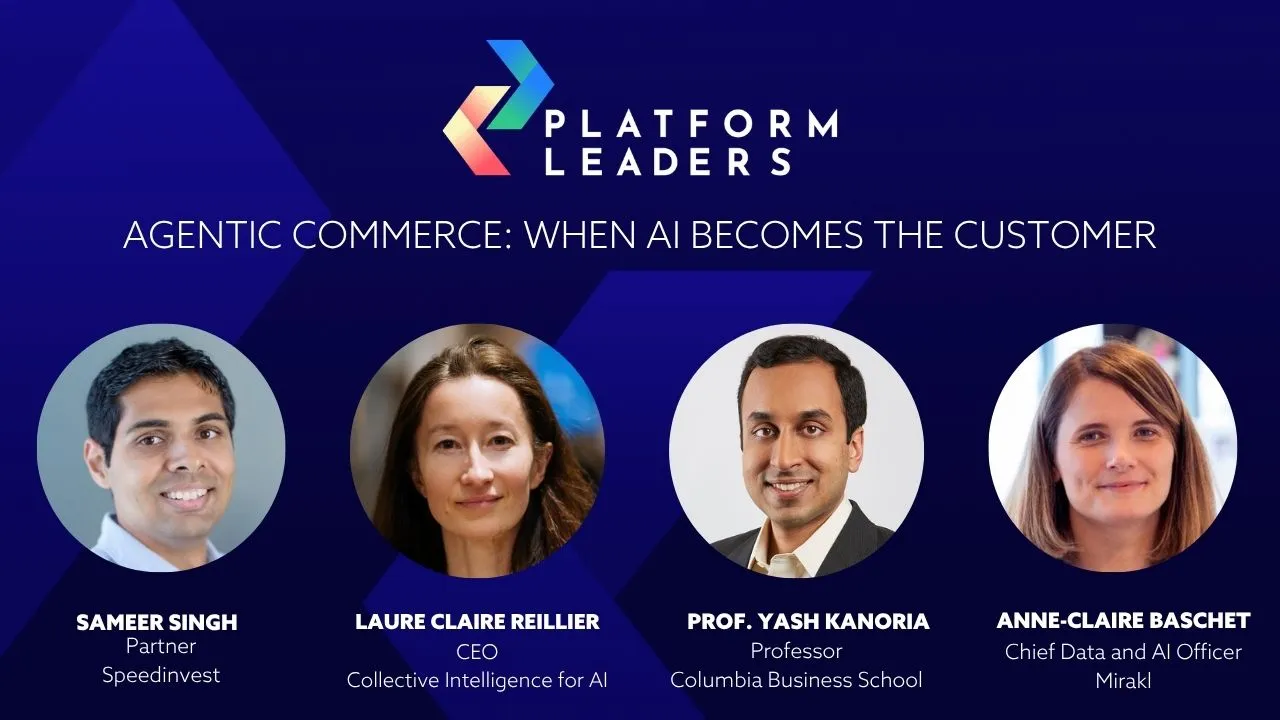
Frontier AI firms may not have set out to build personal shopping assistants. But that is yet another of the emerging use cases for large language models (LLMs): acting as proxies for human shoppers to compare products, weigh prices and make purchase recommendations. There’s a growing sense that the shift to agentic commerce is well under way. “Shopping queries on ChatGPT have jumped from 9% to 14% of all sessions in a year, and nearly half of US shoppers say they use AI to help them buy,” reports Laure Claire Reillier, CEO at Collective Intelligence for AI.
Shopping queries on ChatGPT have jumped from 9% to 14% of all sessions in a year, and nearly half of US shoppers say they use AI to help them buy
For retailers and shoppers alike, shopping does seem poised to change. “Now that agents are choosing products, how do they make a recommendation?” asks Anne-Claire Baschet, Mirakl’s Chief Data & AI Officer, who works alongside marketplaces as they face the implications of agentic commerce’s arrival.
The answer, at least in part, is that these agents don’t reason the way a human shopper would – and this has the potential to reshape the e-commerce landscape.
What do agents buy, and why?
AI product recommendation behaviour is the subject of recent research by Yash Kanoria, Professor at Columbia Business School. His report on AI-mediated online marketplaces, titled What Is Your AI Agent Buying? Evaluation, Implications, and Emerging Questions for Agentic E-Commerce, was published in 2025. “The question we were interested in is ‘can we understand the choice behaviour of these AI tools, if I ask them to go out and compare and choose on my behalf?’” he recounts.
Yash and the research team built a simulated online marketplace, which allowed them to control for various parameters that could influence a purchasing decision. “We were interested in how [the agent] makes trade-offs between different attributes, whether it’s price or rating or platform tags or the position of the product in the display,” explains Yash. “When [an agent] makes a choice on a website, you don’t know what is driving that choice. […] You can ask it, but you can take its answer with a pinch of salt. The explanation doesn’t always match the actual choice behaviour.”
You can ask it, but you can take its answer with a pinch of salt. The explanation doesn’t always match the actual choice behaviour.
The team’s study found that identical product displays can produce different outcomes depending on which model is doing the choosing. Asked to recommend a fitness watch from a set of eight product listings, GPT-4.1, GPT-5.1 and Claude Opus each selected different products, despite being shown the exact same display. “There’s obviously model dependence,” notes Yash.
Further simulations involved reordering the products’ listing positions. GPT-4.1, when presented with a differently ordered display of products, changed its selection each time and showed a measurable bias toward whatever product was displayed in the top-left position. It recommended a product in that position roughly three times more often than chance would predict. Meanwhile, GPT-5.1 has the opposite tendency and favours the bottom-right positions. Gemini models display yet another pattern; certain models also weight other product factors more heavily. “Some of the GPT 5.x models care about ratings twice as much as their predecessors,” adds Yash.
Interestingly, none of Yash’s findings correspond to established patterns of humans’ purchasing behaviour. An agent’s preferences can also shift substantially with each new model release, in ways that seem to be dependent on a given model’s internal architecture.
AI agent bias: a by-product of training
The specifics of that internal architecture may offer an explanation for why AI agents are displaying these biases. LLMs are typically refined using reinforcement learning, a process that performs well when there is a clear right or wrong outcome to learn from. “Say you get an AI model to play a game, and lots of different outcomes happen, and one of the times it gets something right and wins the game,” explains Sameer Singh, Partner at Speedinvest. “The way reinforcement learning works is you ask the model, the one that got [the game] right, ‘trace back your sequence of events and just upweight everything you did’.” For agents specialised in coding or other tasks with more binary outcomes, this training method is highly effective. However, Sameer says: “You can’t do that in shopping.”
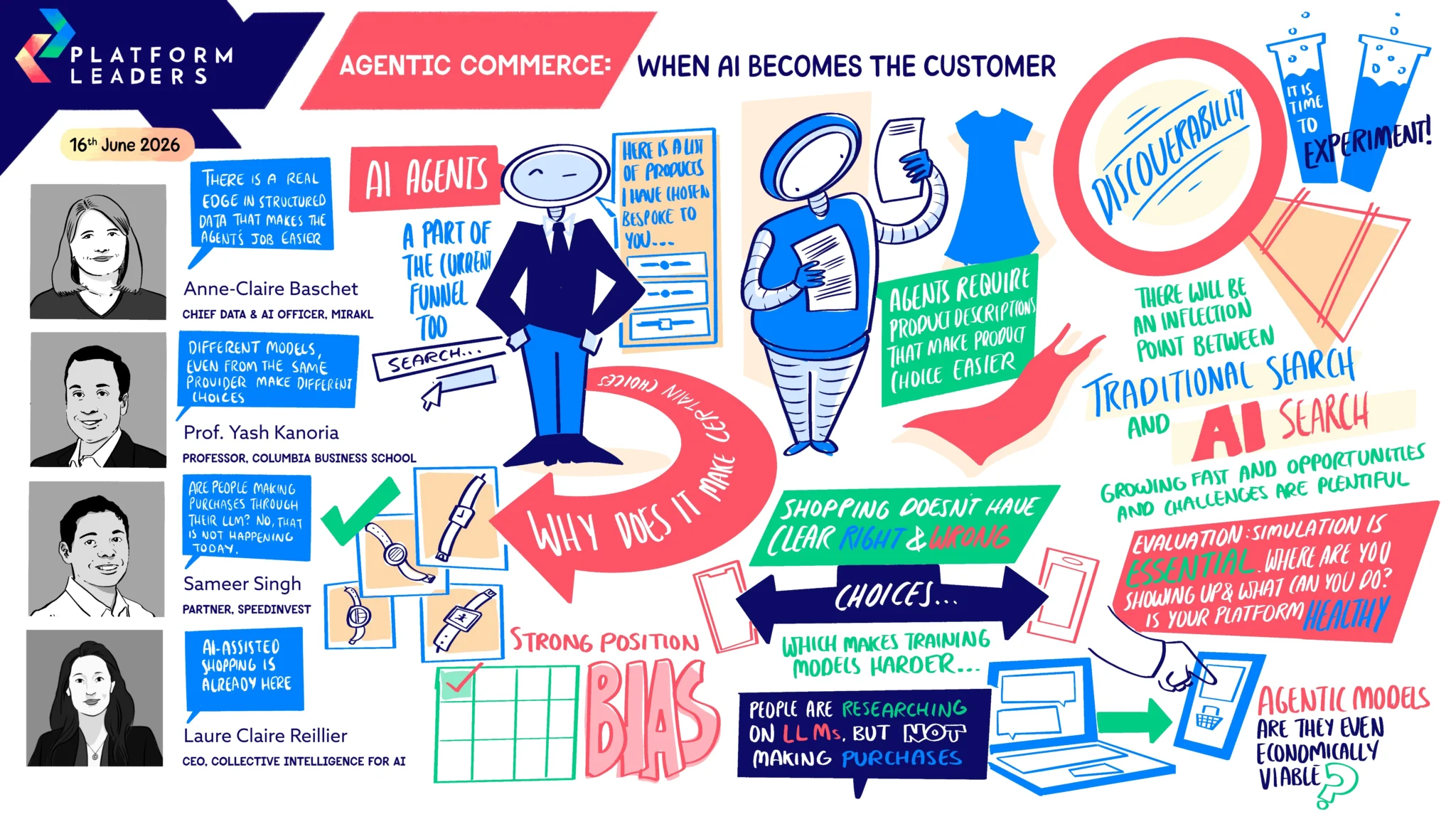
In an e-commerce environment, there are no equivalent signals that confirm to an agent that a purchase decision will always be correct. Sameer illustrates: “There’s 10 different users shopping for the same product; all 10 of them would have different priorities.” Those consumers could each arrive at their own ‘correct’ answer, depending on their budget, taste and needs. In the absence of a clear training signal, idiosyncrasies such as positional bias or a sudden shift toward favouring high ratings emerge. This also explains why instructing a model to “recommend a diversity of products,” as Yash also notes from his experiments, doesn’t help to alter its behaviour: these tendencies can’t be adjusted through prompting alone.
From initial anxiety to strategic response
In Anne-Claire’s view, the reorientation towards agentic commerce has presented retailers with a great deal of uncertainty, but she thinks the fog is already beginning to lift. “When Perplexity launched their agentic commerce approach in October 2024, when the retailers and the brands were no longer the merchant of record, that was a problem for them,” she remembers. “There was fear about disintermediation, [that] what has happened in travel and in hotels and so on is going to happen to retail.”
More recent developments have proven reassuring. “The protocols that OpenAI and then Google have launched – agentic commerce protocol and universal commerce protocol – bring more clarity toward the ecosystem,” Anne-Claire thinks. “[Retailers] still receive the payment, you still have the customer data, you still are able to engage in a relationship with [customers].” With major fears about disintermediation calmed, firms are now increasing their efforts to improve visibility and discoverability.
Retailers are already adapting, and some are seeing results
Whereas traditional search engines were concerned with matching keywords, AI agents are solving multi-part problems expressed in natural language. “In the way marketplace and retailers and brands structure product data today, they are not always giving the structured information that will help an agent,” says Anne-Claire. In her experience, including details – such as occasion, purpose and frequently asked questions – within the product data measurably improves the likelihood that an agent selects a given product over a competitor’s. “There is a real edge [by] providing structured data that are making the job of the agent easier,” she thinks.
There is a real edge [by] providing structured data that are making the job of the agent easier.
Early results seem to be confirming Anne-Claire’s assessment. One of her marketplace clients that focused on product assortment, stock availability and transparent pricing saw its visibility in ChatGPT-generated recommendations rise by 24 percentage points, enough to outrank Walmart and Amazon within its category. A smaller specialty retailer achieved comparable success through an early-mover strategy, securing a position among the top three recommended sellers in its category alongside considerably larger competitors.
For now, agents are responsible for just a small fraction of the traffic that most e-commerce businesses attract. “But it’s growing, and it’s driving higher conversion than classical referral traffic,” according to Anne-Claire. Her clients are doubling down on their AI agent discoverability: “They are learning that it’s a good way for them to capture a new segment of customers,” she says.
Fully agentic commerce: further away than we think?
Although AI-assisted shopping is certainly up and running, the road to fully agentic commerce may still be long. “The research reports are making five-year forecasts of things that aren’t happening [yet],” Sameer thinks. In his experience, the user uptake in shopping agents is sluggish compared with other AI specialist agents. “I have come across a fair number of startups that claim to be involved with agentic commerce in some way, shape or form,” he says emphatically. “How much traction do these companies have? None. I have not come across a single agentic commerce startup that has a meaningful number of users.”
I have not come across a single agentic commerce startup that has a meaningful number of users.
Sameer sees two structural reasons for this gap; the first concerns user experience. “Where LLMs work well in terms of a user interface is [when] they lower cognitive load of a high-cognitive-load task, like writing a long draft, generating media, writing code,” he says. In those cases, “it’s a whole lot easier to send a few lines to an LLM”, but he adds, “once you have a rough idea of what you want, you want a menu to scroll [through], and that’s not something LLMs are good at.” Once a shopper has narrowed down their options, they tend to prefer scrolling and visual comparison. Therefore, a chat-based interface could introduce friction at precisely the point where shopping becomes easiest for humans to complete unassisted.
The second issue, as Sameer sees it, is one of economics. “Coding models, which are the heart of agents, are the most compute-intensive technology built in history,” he says. After decades of declining costs in the technology sector, the resource demands of AI models have pushed prices higher and placed strain on supply chains: “Over the last couple of months, you’ve had companies getting sticker shock as to how much this actually costs when they try to push AI adoption across the organisation.” For his part, Sameer is not convinced that large-scale agentic commerce will be possible as long as these conditions are in place. “The assumption behind agentic commerce is that an end user will be able to run an autonomous agent on their phone without paying anything for it. So, who, exactly, is paying for the agent? The marginal costs are massive. The CapEx requirements are massive. This is just not economically viable,” he thinks.
Unpredictability as the new constant
While much about the future of agentic commerce is unclear, there can be value in returning to proven principles. “The rules of commerce are still true. It’s still [about] having the right price with the right level of service and matching the demand of the customer,” thinks Anne-Claire. She has straightforward advice for online marketplaces: “Invest drastically on what makes a good retailer [… and] work on [having] a strong data foundation.”
The rules of commerce are still true. It’s still [about] having the right price with the right level of service and matching the demand of the customer.
For his part, Yash echoes this pragmatism and recommends caution over carelessness. “You need to keep evaluating and understand what’s happening, and then you can think how you want to react to it,” he says. He also acknowledges that firms will need to foster resilience: “There will be opportunities as well as challenges, and they will come and go in these phases.”
Shape the future with Platform Leaders
This panel with Anne-Claire Baschet, Yash Kanoria, Laure Claire Reillier and Sameer Singh took place at the Platform Leaders event organised by Launchworks & Co, held online on 16 June 2026. For full recordings, in-depth insights and updates on upcoming events, visit the Platform Leaders website and join the community.
To watch the full event, you can play the video below.
Share this: